
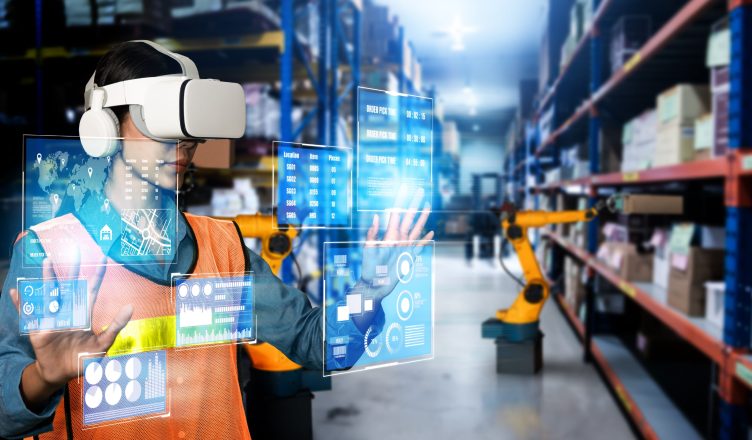
You know that feeling when you try to assemble furniture with a flat, 2D manual? Or when you buy a sofa online, only to realize it’s way too big for your living room? Honestly, it’s frustrating. That gap between the digital and physical worlds is exactly what spatial computing and augmented reality (AR) are designed to bridge.
Let’s be clear: this isn’t just futuristic hype. It’s a fundamental shift in how we interact with information. Spatial computing allows digital content to understand and interact with the real, three-dimensional space around you. AR is its most visible face—overlaying that digital content onto your view of the world. And for businesses, the applications are moving from neat demos to essential tools. Let’s dive into two areas where the impact is already profound: retail and corporate training.
Transforming the Retail Experience: From Browse to “Wow”
Retail’s biggest challenge? Connecting online convenience with in-store confidence. Spatial computing tackles this head-on, creating a blended, “phygital” journey. Here’s the deal—it’s about enhancing reality, not replacing it.
Virtual Try-On and Visualization
This is the big one. AR lets customers project products into their personal space. Think: seeing how a new paint color looks on your actual wall, or how that coffee table fits between your sofa and TV. It’s a game-changer for reducing returns and boosting purchase confidence.
Fashion and beauty brands are all over this. Apps now let you “try on” glasses, makeup, or even entire outfits from your phone camera. It’s fun, sure, but it’s also incredibly practical. No more guessing if that shade of lipstick works for you.
In-Store Navigation and Enhanced Information
Imagine walking into a large home improvement store. Instead of wandering aisles, you open an app, input your shopping list, and see a glowing path on your screen guiding you to each item. That’s spatial navigation.
Point your phone at a product, and layered reviews, specs, or even video tutorials pop up. This turns every shelf into an interactive display, empowering associates with better info and letting customers self-serve efficiently. It’s like having a super-knowledgeable shopping buddy right in your pocket.
Data-Driven Store Design and Operations
Behind the scenes, spatial computing helps retailers understand space. Using AR headsets or sensors, managers can visualize heatmaps of customer flow, test new shelf layouts in 3D before moving a single physical product, or get guided picking routes for online orders in the warehouse. It turns guesswork into a precise science.
| Retail Application | Customer Benefit | Business Benefit |
| AR Product Visualization | Reduces purchase anxiety, increases accuracy. | Lowers return rates, boosts conversion. |
| In-Store AR Navigation | Saves time, enhances discovery. | Increases basket size, improves CX. |
| Spatial Analytics for Layout | (Indirect) Smoother shopping experience. | Optimizes floor plans, increases sales per sq. ft. |
Revolutionizing Corporate Training and Skill Development
If retail is about external experience, training is about internal capability. And here, spatial computing isn’t just an improvement—it’s a paradigm shift. Forget dusty binders or click-through e-learning. This is learning by doing, in a risk-free environment.
Immersive, Hands-On Simulations
This is the killer app for training. Need to learn how to repair a complex jet engine? Or perform delicate surgery? With AR, you can practice on a hyper-realistic, 3D model that’s superimposed onto your workspace. Tools, parts, and step-by-step instructions appear right where you need them, guided by your gaze or gestures.
The muscle memory you build is real. The consequences of a mistake are not. Trainees can repeat procedures endlessly, building competence and confidence before ever touching real, expensive equipment—or a patient.
Remote Assistance and Knowledge Transfer
Here’s a common pain point: a field technician is stuck on a problem. Instead of a confusing phone call, they put on AR glasses. A remote expert can see their live view and annotate the real world in front of them—drawing arrows, highlighting components, pulling up manuals. It’s like having the expert’s eyes and hands right there.
This slashes downtime, preserves critical institutional knowledge, and upskills workers faster. Honestly, it’s a no-brainer for industries with distributed workforces.
Soft Skills and Safety Training
Spatial computing isn’t only for hard skills. Imagine practicing a difficult conversation with a virtual avatar that reacts emotionally. Or navigating a VR simulation of a hazardous construction site to learn safety protocols. The emotional and cognitive recall from these immersive experiences is far stronger than from reading a policy document.
Learners aren’t just told what to do. They experience the scenario and its outcomes. That’s powerful.
The Tangible Benefits: Why Businesses Are Betting on This
Beyond the “cool factor,” the ROI is becoming impossible to ignore. We’re talking about:
- Major cost reduction: Fewer product returns, less training downtime, lower physical training material costs.
- Enhanced efficiency: Faster task completion in stores and warehouses, accelerated learning curves for employees.
- Improved accuracy & safety: Fewer errors in complex assembly or maintenance, a stronger safety culture.
- Deeper data insights: Understanding how people move and interact with spaces, both customers and employees.
Looking Ahead: The Blended Future is Spatial
The line between our digital and physical workflows is blurring—for good. As the hardware (think: lighter glasses, better sensors) becomes more accessible, these applications will move from pilot projects to standard operating procedure.
That said, the goal isn’t to make everyone wear goggles all day. It’s about providing a seamless, intuitive layer of information when and where it’s most useful. Whether it’s a customer figuring out if a rug matches their decor, or a technician learning a life-saving procedure, the core promise is the same: empowering people with context.
The future of business isn’t just digital. It’s spatial. And that changes everything.