
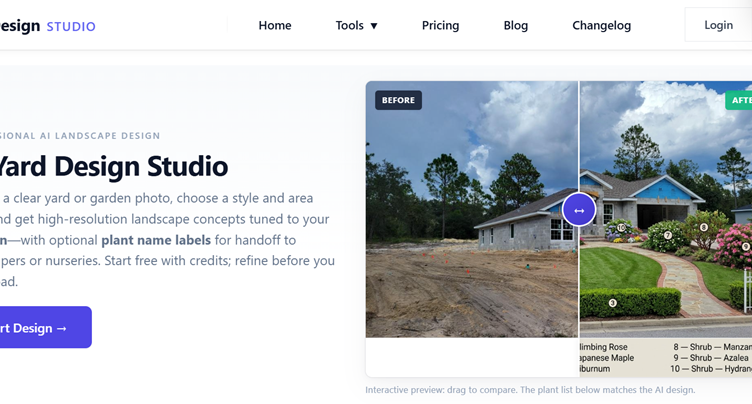
Creating a better yard can be exciting—and also slow, expensive, and oddly abstract long before you spend money on stone and soil. Families negotiate in adjectives. Contractors ask practical questions that expose missing decisions. Nurseries hear “modern,” “lush,” or “low maintenance” without a visual that maps to real plants, spacing, and maintenance reality. Traditionally, getting aligned meant waiting on schedules, paying for early design work, or collecting inspiration photos that were never shot on your slope, your fence line, or under your trees. The hidden cost is not taste. It is misalignment: deciding too late, changing too expensively, and discovering—after materials are moving—that everyone was picturing a different property. AI Yard Design Studio is built for the part of the project where those failures start: the moment you need a shareable landscape vision that still respects your yard as it exists today. The workflow is intentionally simple to describe: upload a contextual outdoor photo, choose the kind of outdoor space you are improving, set a clear design direction, add your constraints in plain language, generate concepts, then refine in layers until the image matches the brief you can defend in a meeting.
Fast does not mean “fake.” It means “iterable.”
For many homeowners, AI landscape design only becomes truly useful when it is iterable—and that is the real meaning of “fast” here. “Fast” is not a promise that construction becomes instant. It is a promise that visual iteration can happen in minutes, not weeks—so you can compare directions while you are still flexible. Most runs are designed to complete in about a couple of minutes, with larger high-detail outputs sometimes taking longer depending on settings and load. That timing matters because it changes how decisions feel: less like a commitment, more like exploration—until you choose a direction worth sharing.
Start with a photo that tells the truth about your site
AI Yard Design Studio begins with a real yard or garden photograph because outdoor design is site-specific. If you crop out your driveway relationship, your property edges, a mature tree you are keeping, or existing hardscape you must work around, you are asking the system to invent a different lot. If you do not have a photo ready, you can still learn the workflow using sample images—but the real payoff arrives when you return with a contextual shot: enough information that a spouse, a designer, or a contractor can say, “Yes, that is our space—now let’s argue productively about what changes.”
Zone-first planning: the right question before the pretty answer
Front yards, backyards, side yards, garden retreats, and pool surrounds are not interchangeable problems. AI Yard Design Studio organizes generation around home-scale outdoor zones so the tool is not guessing which job you mean. Within that structure, you select a required style direction, add optional elements, and write additional requirements the way you would write a brief: screening needs, pet paths, maintenance tolerance, features you refuse, and what must be preserved. Style without constraints produces pretty ambiguity. Constraints produce decisions.
Location context: steer results toward believable outdoor outcomes
One of the most common AI failures in outdoor work is climate fantasy: a look that belongs to another region. AI Yard Design Studio includes optional location context to bias planting palettes and materials toward outcomes that feel more appropriate where you live. The honest framing is what makes the feature trustworthy: location context is a realism lever, not a guarantee. It does not replace nursery inventory checks, invasive-species diligence, or local professional judgment. It reduces the gap between “internet beautiful” and “plausible here.”
Draft exploration, then a shareable concept
AI Yard Design Studio separates fast layout exploration from higher-detail concepts you can actually share. A quicker draft tier is built for comparing circulation, openness versus enclosure, and hardscape versus planting emphasis—without paying for a presentation-grade render too early. When you need sharper detail, a higher-quality tier targets a more meeting-ready image and may include on-image plant callouts useful for discussion. Treat those callouts as reference prompts, not botanical certification. Mature size, winter hardiness, water needs, and availability still require human verification. The win is alignment speed: you arrive at expertise with direction. Credits and resolution choices are part of the product’s transparency—so you can iterate cheaply while ideas are fluid, then invest when you have a version worth emailing to a landscaper or bringing to a nursery consult.
Fine-tune in layers instead of restarting from zero
Outdoor design is iterative. AI Yard Design Studio supports fine-tuning—adjust pathway materials, planting emphasis, and common outdoor amenities—plus custom instructions for the one change that must land without throwing away a mostly-right concept. That matches how real projects move: hardscape logic, then planting structure, then accents. If you change everything at once, nobody knows what improved—or what broke a constraint.
When your project is bigger than a home lot
AI Yard Design Studio is built for residential outdoor rooms. If you are working on parks, campuses, commercial grounds, or street-scale outdoor environments, use the platform’s large-scale landscape lane so your brief matches the scale of the decision—and you do not force the wrong tool on the wrong problem.
Try it: a simple workflow you can run today
If you want a shareable landscape vision grounded in your property:
- Photograph your outdoor space with enough context to be honest.
- Open the Yard & Garden generator on ai-yard-design.com, choose the correct zone, and set a coherent style direction.
- Add elements and written requirements like a real brief.
- Include location context if plant believability matters to you.
- Generate a draft pass, compare directions, then move to higher detail when you are ready to share.
- Fine-tune in layers, and verify planting and construction assumptions with local expertise.
Conclusion: speed where it saves money
AI Yard Design Studio will not pour concrete for you. It will not replace drainage thinking, codes, or site verification. What it can do—fast—is turn a yard photo into a landscape vision people can point at, critique, and refine before the expensive part of the project locks in. If your goal is earlier alignment, fewer circular conversations, and a concept that still looks like your address, start with a truthful photo and iterate like you mean it. That is how a yard project stops being a debate about adjectives—and becomes a plan you can finally build.